Applying Paint Protection Film (PPF)—often called “Clear Bra” or “Invisible Car Clothing”—has become a standard procedure for many owners after picking up a new car. However, when doing research, you will inevitably encounter two high-frequency terms: TPU and TPH.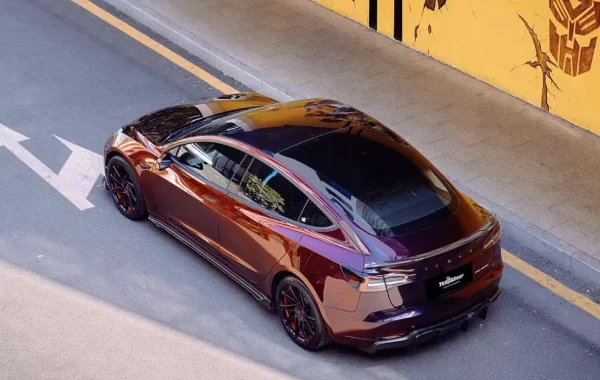
Why do some films cost only $500, while others cost over $2,500? The core difference lies in the material. Today, we will break down the differences between TPU and TPH to help you avoid pitfalls and spend your money wisely.
I. Core Essence: What Exactly Are They?
To understand the difference, we must first look at their “DNA”:
- TPH (Essentially Plastic)
Its Origin: TPH is actually an “improved” version of traditional PVC (Polyvinyl Chloride).
Its Method: To solve the problem of PVC being too hard to wrap around curves, manufacturers add a large amount of plasticizers to make it soft.
Its Nickname: In the industry, it is known as “Low-end PPF” or “Fake PPF.”
- TPU (Essentially Rubber)
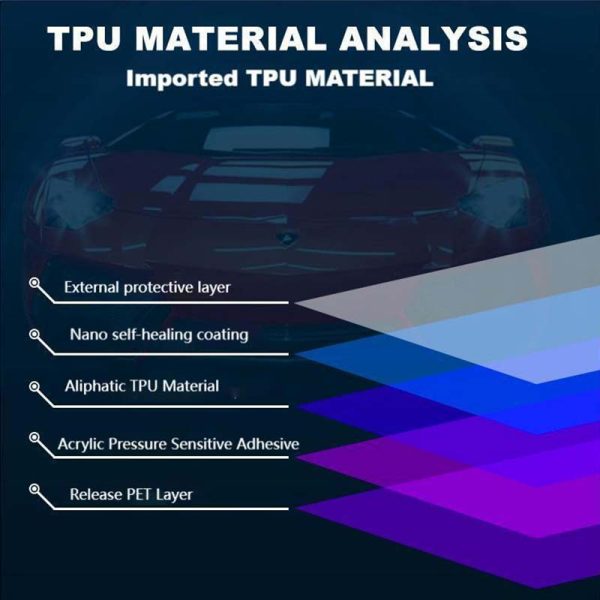
Its Definition: TPU (Thermoplastic Polyurethane) is a polymer material with rubber-like elasticity.
Its Talent: It naturally possesses extreme toughness and stretchability, requiring no messy additives or plasticizers.![]()
Its Nickname: The true “Invisible Car Clothing.”
II.Deep Dive: Why TPU Completely Beats TPH
Let’s compare them across the 5 real-world scenarios that car owners care about most:
- Scratch Repair Ability
TPU: Possesses a magical “memory function.” When encountering fine swirl marks or car wash scratches, simply parking in the sun or pouring hot water on it will cause the molecular structure to restore itself, making scratches disappear instantly.
TPH: Has almost no repair capability. A scratch is permanent. Because the material is soft yet brittle, it is actually more prone to deep scratching.
- Anti-Yellowing & Aging
TPU: Extremely stable structure. High-quality Aliphatic TPU can remain clear without obvious yellowing for 3-5 years or more, keeping the paint looking glossy.
TPH: This is its fatal weakness. Because the plasticizers evaporate over time, the film will turn noticeably yellow and cloudy within 6-12 months. If you apply this to a white car, it will turn into a “yellow car.”
- Toughness & Protection
TPU: Like a rubber band, it rebounds no matter how much you stretch it. If hit by a stone at high speed, it absorbs the impact through elastic deformation, protecting the original paint.
TPH: If you stretch it with a little force, it turns white and cracks. When hit by hard objects, it is often punctured immediately, sometimes allowing the damage to go straight through to the paint.
- Residue Risk (The Most Important Point)
TPU: Good TPU combined with high-quality pressure-sensitive adhesive will leave the paint clean even after being removed years later.
TPH: Known in the industry as “Easy to apply, a nightmare to remove.” As the plasticizers serve their purpose and leave, the glue layer hardens and fuses to the car paint. When removing the film, it often requires harsh chemical removers, and in severe cases, it can peel off the original clear coat.
- Price Difference
TPU: High raw material costs. Market prices usually range from mid-to-high budget (e.g., $1,000 – $3,000+).
TPH: Cheap materials. Market prices are usually low budget (e.g., $300 – $600).
III. Simple Tricks to Identify Real TPU
Many sellers in the market will package TPH as “Enhanced,” “Nano-level,” or other marketing buzzwords to fool consumers. When shopping, be sure to perform these three tests:
The Stretch Test (Check Toughness):
Cut a small piece of film and pull it hard. If it stretches very long and rebounds quickly, it is TPU. If it is hard to pull, and the stretched area turns white or shows cracks, it is TPH.
The Thumbnail Test (Check Repair):
Use your fingernail to press a dent into the film surface deeply. TPU will rebound and flatten out within seconds. TPH will leave a dead dent that is difficult to recover.
The Burn Test (Check Smell):
Ask the shop for a scrap piece and burn it with a lighter.
TPU: Smells relatively mild, like ethanol (alcohol), and the residue is a viscous liquid.
TPH: Emits black smoke, has a pungent plastic smell, and the residue turns into hard, black clumps.
IV. Final Verdict: How Should You Choose?
Returning to your wallet and needs, here is the most honest advice:
❌ When NOT to choose TPH
Many owners think, “You get what you pay for, but a cheap one is better than nothing.” This is wrong.
If your budget is very low (e.g., under $500), I suggest you do not wrap the car at all. Save the money for high-quality waxing or ceramic coating. The money you save buying TPH will not be enough to cover the cost of glue removal and paint correction two years later.
✅ When to choose TPU (Blind Buy)
New Car Delivery: You want to keep the original paint in perfect condition.
Long-term Ownership: You plan to keep the car for 3+ years and don’t want to pay to peel off cracked film later.
Expensive Paint: Such as Mazda’s Soul Red, matte finishes, or luxury brand option paints where repainting costs are astronomical.
Buying Tip
Within the TPU camp, try to choose “Aliphatic TPU”. Although it is more expensive, it is currently the ceiling for anti-yellowing capabilities—an absolute must for white and light-colored cars.

 English
  العربية
  Русский
  Português