Для чего нужна тонировка автомобильных стекол? Помимо защиты от жары и солнца!
Академия / Пленка для автомобильных стекол
Car window tint offers more than heat rejection. It provides five key benefits: shatter protection, UV blocking, glare reduction, privacy, and fuel efficiency. It is a vital investment for safety and health, not just for staying cool.
When Car Window Tint is mentioned, the first reaction of most car owners is often: “It’s too hot in the summer; I’ll get it tinted to stay cool.”
Indeed, high-quality heat-rejection films can effectively block infrared rays and lower the temperature inside the car. However, among car owners searching on Google, more and more are realizing that heat rejection is just one of the basic functions of window film. What truly makes high-quality window tint worth the investment is the comprehensive improvement it brings to safety, health, and the driving experience.
If you are still hesitating about whether to tint your car, or if you are only focused on heat rejection parameters, you may be missing out on these 5 crucial functions. 1. The “Bodyguard” in Critical Moments: Safety & Shatter Protection
This is the most important, yet most frequently overlooked function of window tint.
Car side and rear windows usually use tempered glass. When a serious collision occurs or the glass is hit by a hard object, tempered glass instantly shatters into countless granular pieces. Although these granules are not sharp shards, high-speed flying glass fragments can still cause secondary injuries to the occupants inside (especially to the eyes and face).
How Window Tint Works:
High-quality window film possesses a tough pressure-sensitive adhesive layer. When the glass breaks, the film acts like a strong net, holding the shattered glass tightly together and preventing fragments from splashing. This often plays a critical protective role during highway accidents or unexpected impacts. 2. 99% UV Block: Protecting Skin & Interior (UV Protection)
Many people confuse “Heat Rejection” with “UV Blocking.”
* Heat Rejection: Primarily blocks Infrared (IR) rays (the heat source).
* Sun Protection: Primarily blocks Ultraviolet (UV) rays.
Even in winter or on cloudy days, UV rays are still present. If you drive for long periods without tint, the side of your face next to the window is effectively exposed to long-term UVA radiation, accelerating skin aging and even increasing the risk of skin cancer.
Furthermore, the invisible killer of car interiors is also UV radiation. Cracked leather seats, faded dashboards, and aging, brittle plastic parts are largely the result of long-term UV exposure. A high-quality window film can typically block 99% or even 99.9% of UV rays, which is equivalent to applying a permanent layer of high-SPF sunscreen to the entire vehicle.
3. Enhancing Driving Safety: Glare Reduction
Have you ever encountered the following situations?
* When driving against the sun during the day, the blinding sunlight makes it hard to see the road conditions.
* When driving at night, the high beams from the vehicle behind you are blinding through the rearview mirror.
This is Glare. Glare not only causes eye fatigue but is also a common cause of traffic accidents. Window tint can effectively filter strong light and soften the illumination by reducing Visible Light Transmission (VLT) and using special light-filtering coatings. This significantly improves visual comfort while driving, allowing you to react more quickly to road conditions. 4. Creating a Private Space: Privacy Protection
For many car owners, the car is a “third space” outside of the home and office.
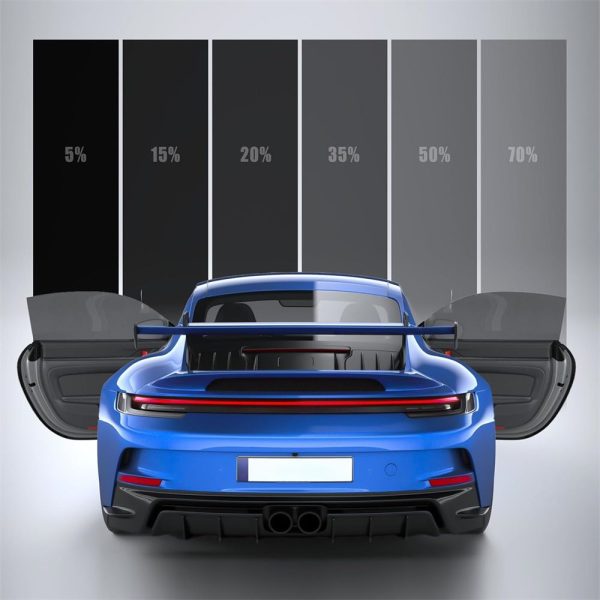
By choosing films with lower light transmission (e.g., 15%-35%) for the side and rear windows, you can effectively prevent prying eyes from outside. This not only protects the privacy of passengers inside (especially nursing mothers or passengers resting in the back) but also acts as a theft deterrent.
Anti-Theft Logic: Thieves usually have a habit of peeking inside the car first to see if there are valuables (such as handbags or laptops). If they cannot see the interior clearly, they will generally not rashly smash the window, thereby reducing the risk of theft. 5. Aesthetics & Fuel Efficiency
* Aesthetics: A set of window tints with uniform color and high-quality texture can instantly elevate the appearance of the vehicle, making the car’s lines look smoother and more mysterious.
* Fuel Economy: This points back to “heat rejection.” Because the internal temperature is lower, the workload of the air conditioning compressor is reduced, thereby indirectly lowering fuel consumption (for gas cars) or increasing range (for electric vehicles).
How to Choose the Right Window Tint?
After understanding the various uses of window tint, how do you choose? Besides the brand, you need to focus on these three core parameters:
* Visible Light Transmission (VLT): Determines the darkness of the film. For the front windshield, it is recommended to choose VLT > 70% to ensure clear vision; for side and rear windows, choose 15%-35% based on privacy needs.
* Infrared Rejection Rate (IRR): Determines the heat rejection effect. The higher the number, the better the heat insulation.
* Ultraviolet Rejection Rate (UVR): Determines the sun protection effect. High-quality films are usually above 99%. Summary
What is the use of car window tint? The answer is clearly not just “staying cool.” It is a comprehensive investment in safety, health, and privacy.
Rather than calling it a car accessory, it is better described as a “shield” for your car. When choosing window tint, it is recommended that you do not just stare at the price, but pay more attention to its shatter-resistant performance, anti-glare capability, and UV blocking rate. Choosing a genuine, high-quality window film adds peace of mind to every trip for you and your family.
FAQ (Frequently Asked Questions)
Q: Is darker window tint better for heat rejection?
A: Not necessarily. Modern ceramic film technology can achieve extremely high infrared rejection rates even with very light colors. Dark colors mainly provide privacy and do not completely represent heat rejection performance.
Q: What should I pay attention to after tinting?
A: It is generally recommended not to roll down the windows for 3-7 days after installation to prevent the film from shifting or bubbling. The specific time depends on the weather and the type of film used.
Свяжитесь со мной
Компания WooMagicar обслуживает более 300 магазинов 4S и региональных дилеров, предлагая прямые поставки с завода, оптовые скидки, бесплатное тестирование образцов, индивидуальный подбор продукции и эксклюзивное региональное сотрудничество. Свяжитесь со мной в любое время для уточнения сроков поставок, условий гарантии или вопросов сотрудничества в офлайн-режиме.

 English
  العربية
  Русский
  Português